
Under the microscope: Blues Brothers 2000 (Nintendo 64)
How did nobody find these cheats?
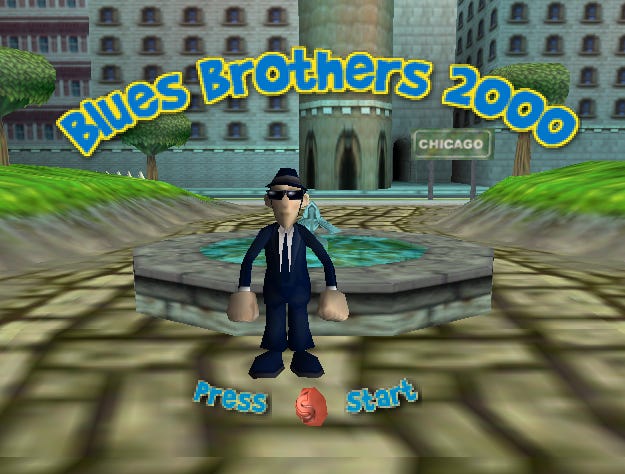
Blues Brothers 2000, the film, was released in February of 1998. Blues Brothers 2000, the Nintendo 64 game, was released more than 2½ years later. Well, at least they got it done before 2000 ended.
I found a batch of cheat codes for this unlikely platformer that don’t seem to have been published before. In addition, I found evidence of some more cheat functions that seem to be disabled.
Details on the cheat codes and the reverse engineering involved in uncovering these hidden things are below…
The cheats
Enter this sequence with the D-pad during gameplay to turn your character into a giant head:
Left, Left, Right, Right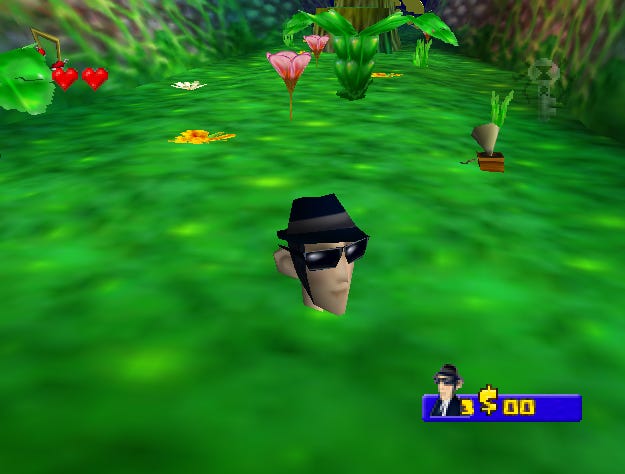
To give yourself an extra life, enter this sequence:
Right, Right, RightYou can repeat this as many times as you like.
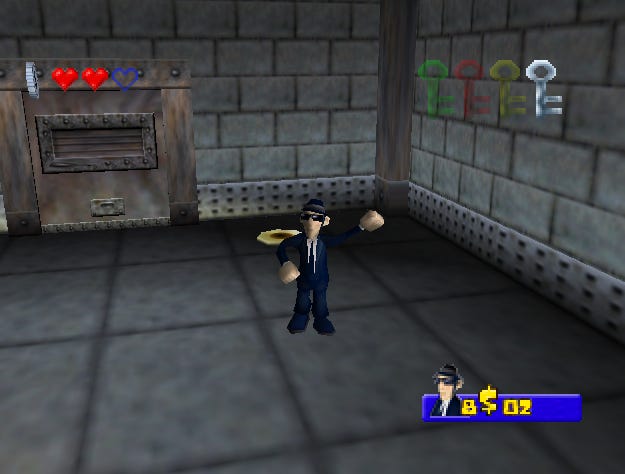
To get seven extra dollars, enter this sequence:
Left, Left, Left, Right, RightYou can keep entering this one, too.
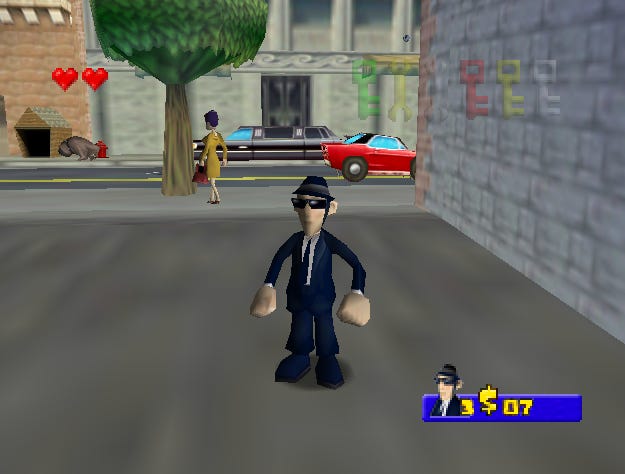
To turn your character into the Player 1 mascot, enter:
Right, Right, Right, Left, Left, Left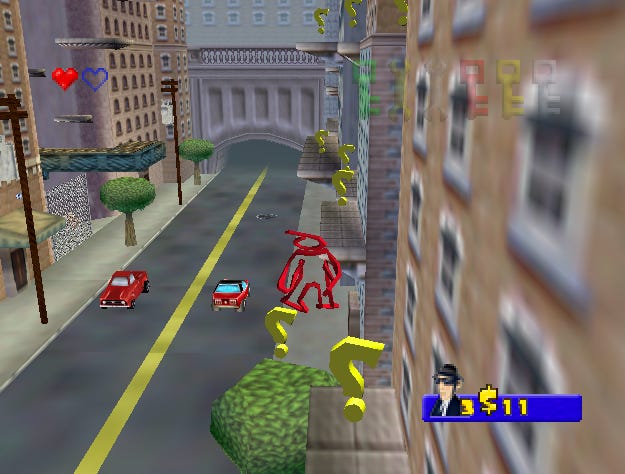
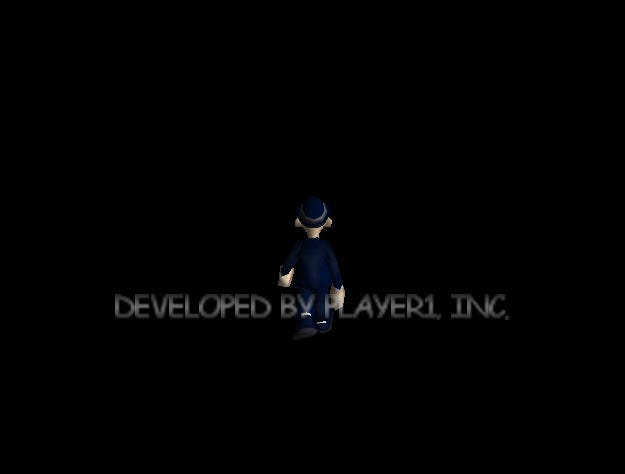
To see partial credits, enter this sequence:
Left, Down, Right, DownYou can interrupt them by pressing a button at any time.
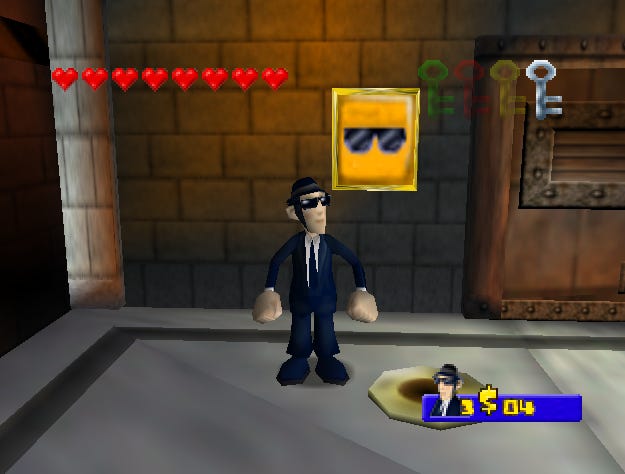
To get eight hearts, enter:
Left, Left, Up, Left, LeftThis both increases your heart capacity to eight and refills your heart gauge. You can keep using it to heal yourself after taking damage.
Technical details and unused features
As usual, I started mapping out this game’s code by figuring out where it listens for controller input. There are a few ways to do this, but the simplest is to take memory snapshots before and while pressing a controller button, and then look at where those snapshots differ.
This game stores “the button you just pressed” at memory address 801070a0. I traced references to that in Ghidra after loading one of the memory snapshots into it. Cheat codes usually compare controller buttons to sequences of values, so I looked for functions that read that address in a loop.
That led me to the function at 80014a84, which checks 17 different code sequences. A pointer to each sequence is stored in an array of structs at 800aa394. Each struct has these elements:
A pointer to the button sequence
A pointer to the function to apply after the sequence is entered
Some sort of status tracker
Whether the code is disabled
There are seven enabled cheats, but I only listed six above. The missing one is:
Right, Left, Right, LeftA sound effect plays when you put it in, but I don’t think it does anything. The function that’s called after entry writes a 32-bit value to address 800b9e9c, but nothing ever reads it.
There are 10 more disabled cheats:
Right, Left, Right
Up, Up, Up
Down, Down, Down
Up, Down, Up, Down
Left, Left, Left, Left
Right, Right, Right, Down
Right, Right, Right, Right
Up, Up, Down, Down
Up, Down, Up
Left, Left, Left
My guess is that these cheats were meant to be activated by the function at 80033b00. It function compares the name of your saved game to these two strings:
marcus
jawad!
If it finds a match, it updates the cheat data structures. However, you can’t rename your save in the retail version of this game or in either of the prototypes.
Who are Marcas and Jawad? Marcus Goodey and Mark Jawad, most likely. They are both credited as programmers for this game. I wonder what else they had in mind for hidden content in this game?
Outro
Thanks for reading Rings of Saturn. I’ll be back next week with a slate of articles about Easter eggs hiding out in Saturn, PlayStation, PlayStation 2, and GameCube games. Subscribe here on Substack to get those as soon as the come out.
These are insane! As a member of the BB2000 speedrun community, it's incredible to see these! We've often joked about how they purposely didn't add credits to the games because no one would want to be remembered for being associated with the game. This game is truly a masterpiece though, and I do sincerely mean that. Thanks for finding these.
I'd like to suggest Shadow Man for N64/PS1, purely because there's a video on YouTube of the N64 version with a debug display, but the uploader never elaborated on how to enable it in the past 15 years! https://youtu.be/p4N-GEYrQCw?si=Z-D638IIk2bfTlFa